

Hussain Abid Syed
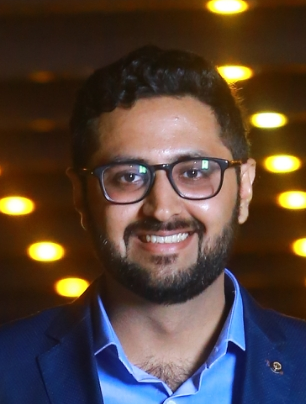
Universität Siegen, BMBF-Arbeitsgruppe KontiKat
Universität Siegen, Campus Unteres Schloss, Kohlbettstraße 17
Mail: Hussain.Syed(at)uni-siegen.de
Room: US-G 006
Phone: +49 (0) 271/ 740 – 4410
More information are only available in German. Please see:
Publikationen
2026
Syed, Hussain Abid; Beck, Dominik; Mueller, Claudia; Wulf, Volker
Designing for workplace well-being: a design case study using aromatherapy as a provocation Journal Article
In: i-com, 2026, ISSN: 2196-6826.
Abstract | Links | BibTeX | Tags: digitalization, SMEs, sociotechnical, well-being, workplace
@article{syedDesigningWorkplaceWellbeing,

title = {Designing for workplace well-being: a design case study using aromatherapy as a provocation},

author = {Hussain Abid Syed and Dominik Beck and Claudia Mueller and Volker Wulf},

url = {https://www.degruyterbrill.com/document/doi/10.1515/icom-2025-0045/html},

doi = {10.1515/icom-2025-0045},

issn = {2196-6826},

year  = {2026},

date = {2026-01-01},

urldate = {2025-11-24},

journal = {i-com},

publisher = {Oldenbourg Wissenschaftsverlag},

abstract = {This paper presents the first design iteration of a case study conducted in a pharmaceutical distribution company to investigate the sociotechnical dimensions of managing stress. Aromatherapy is employed both as a design provocation and as a well-being intervention, aiming to uncover the underlying design imperatives of workplace well-being interventions. We conceptualize the workplace as a sociotechnical infrastructure and emphasize the situated and contextual nature of work practices as central to understanding stress. The case study contributes to HCI research by (1) advancing the understanding of stress as a sociotechnical issue in organizational contexts and (2) offering insights into the design and use of aromatherapy as a non-conventional well-being intervention in the workplace, identifying broader implications and tensions for the design of such technologies.},

keywords = {digitalization, SMEs, sociotechnical, well-being, workplace},

pubstate = {published},

tppubtype = {article}

}
2025
Weiler, Tim; Paluch, Richard; Kirschsieper, Dennis; Procter, Rob; Roman, Deysi Helen Ortega; Syed, Hussain Abid; Tellioglu, Hilda; Hochwarter, Stefan; Lichtenegger, Katharina; Müller, Claudia
Negotiating Extra Work: A Reflection on Participatory Research Practices in Healthcare Proceedings Article
In: European Society for Socially Embedded Technologies (EUSSET), 2025, ISSN: 2510-2591.
Abstract | Links | BibTeX | Tags: italg
@inproceedings{weilerNegotiatingExtraWork2025,

title = {Negotiating Extra Work: A Reflection on Participatory Research Practices in Healthcare},

author = {Tim Weiler and Richard Paluch and Dennis Kirschsieper and Rob Procter and Deysi Helen Ortega Roman and Hussain Abid Syed and Hilda Tellioglu and Stefan Hochwarter and Katharina Lichtenegger and Claudia Müller},

url = {https://dl.eusset.eu/handle/20.500.12015/5296},

doi = {10.48340/ecscw2025_cp02},

issn = {2510-2591},

year  = {2025},

date = {2025-01-01},

urldate = {2025-06-24},

publisher = {European Society for Socially Embedded Technologies (EUSSET)},

abstract = {This reflection paper examines the often overlooked extra work required to conduct and sustain participatory research in healthcare contexts. Scientific projects require forward planning, methodological flexibility and institutional recognition of the additional effort required to enable sustainable participatory research. Drawing on three healthcare-related case studies, we analyse the tensions between formal project objectives and the realities of conducting research in complex, situated environments. Extra work manifests at multiple levels: (1) within the project scope, (2) at the boundary of the project scope, (3) before the project scope, (4) after the project scope, and (5) outside the project scope. While extra work can serve as a driver of innovation and long-term sustainability, it also creates a fundamental tension for researchers who must balance these emerging demands with project goals, institutional frameworks, and personal capacities. Building on existing concepts from CSCW - such as invisible work and articulation work - we systematically apply and extend these perspectives to the domain of technology development in healthcare. By identifying cross-cutting issues in the case studies, such as stakeholder acquisition and co-benefitting, we refine conceptual understandings of infrastructuring, articulation work and situatedness in participatory research. In doing so, we contribute to grounded design and design case study approaches and reflect on the methodological and practical implications of navigating the inherent tensions of adaptive, long-term engagement in healthcare cooperation.},

keywords = {italg},

pubstate = {published},

tppubtype = {inproceedings}

}
Syed, Hussain Abid; Manavi, Mehrbod; Zaidi, Syed Muhammad Salar; Rizvi, Syed Basit Ali; Gerbracht, Marc; Ludwig, Thomas; Wulf, Volker
Prototyping Industry 4.0: Tracing Infrastructural Resonance in a Smart Factory Demo Proceedings Article
In: European Society for Socially Embedded Technologies (EUSSET), 2025.
Abstract | Links | BibTeX | Tags:
@inproceedings{syedPrototypingIndustry402025,

title = {Prototyping Industry 4.0: Tracing Infrastructural Resonance in a Smart Factory Demo},

author = {Hussain Abid Syed and Mehrbod Manavi and Syed Muhammad Salar Zaidi and Syed Basit Ali Rizvi and Marc Gerbracht and Thomas Ludwig and Volker Wulf},

url = {https://dl.eusset.eu/handle/20.500.12015/5323},

doi = {10.48340/ct2025-1008},

year  = {2025},

date = {2025-01-01},

urldate = {2025-07-21},

publisher = {European Society for Socially Embedded Technologies (EUSSET)},

abstract = {With the advent of Industry 4.0, Internet-of-things, and data-centric technologies, the concept of the smart factory (automation of

the factory) has gained traction to make machines more than mechanical artifacts. It creates an ecosystem of technologies providing

infrastructure to embed technological advancements with the emerging needs of the system. However, with the increasing demand

for automation, several socio-technical challenges pertain due to the infusion of several infrastructural layers in the smart factory

settings. We present “Demo Smart Factory”, which automates a logistic pipeline, including dummy manufacturing, quality assurance,

and sorting, and provides control mechanisms on the real-time sensor data based on components and units of the factory to different

stakeholders via a digital twin. Through this exemplary use-case of a logistics smart factory demo, we aim to illustrate the resonance

between different infrastructural layers and highlight key socio-technical factors that shape the design and implementation of smart

factory systems. We also identify key pitfalls that need to be avoided or balanced in realizing large-scale and multi-layered interventions

like a smart factory.},

keywords = {},

pubstate = {published},

tppubtype = {inproceedings}

}
the factory) has gained traction to make machines more than mechanical artifacts. It creates an ecosystem of technologies providing
infrastructure to embed technological advancements with the emerging needs of the system. However, with the increasing demand
for automation, several socio-technical challenges pertain due to the infusion of several infrastructural layers in the smart factory
settings. We present “Demo Smart Factory”, which automates a logistic pipeline, including dummy manufacturing, quality assurance,
and sorting, and provides control mechanisms on the real-time sensor data based on components and units of the factory to different
stakeholders via a digital twin. Through this exemplary use-case of a logistics smart factory demo, we aim to illustrate the resonance
between different infrastructural layers and highlight key socio-technical factors that shape the design and implementation of smart
factory systems. We also identify key pitfalls that need to be avoided or balanced in realizing large-scale and multi-layered interventions
like a smart factory.
Syed, Hussain Abid; Bhattacharjee, Sourav; Adil, Zunera; Seerat, Syeda Ulya; Yousfani, Na-Jeeullah; Kumar, Ayar; Craemer, Thomas; Mueller, Claudia; Wulf, Volker
Personalization by Design: A Case Study on CardaFit’s Appropriation in Workplace Settings Proceedings Article
In: European Society for Socially Embedded Technologies (EUSSET), 2025.
Abstract | Links | BibTeX | Tags:
@inproceedings{syedPersonalizationDesignCase2025,

title = {Personalization by Design: A Case Study on CardaFit’s Appropriation in Workplace Settings},

author = {Hussain Abid Syed and Sourav Bhattacharjee and Zunera Adil and Syeda Ulya Seerat and Na-Jeeullah Yousfani and Ayar Kumar and Thomas Craemer and Claudia Mueller and Volker Wulf},

url = {https://dl.eusset.eu/handle/20.500.12015/5311},

doi = {10.48340/ct2025-1034},

year  = {2025},

date = {2025-01-01},

urldate = {2025-07-21},

publisher = {European Society for Socially Embedded Technologies (EUSSET)},

abstract = {This paper presents an appropriation study of CardaFit, a cross-platform mobile application designed to mitigate the negative health

effects of prolonged sitting among desk workers. The app promotes micro-interventions through brief, repeated health reminders

that encourage hydration, movement, physical activity, and regular breaks during work hours. CardaFit integrates practice-centered

design with personalized notifications, gamification elements, and meal recommendations. The system emphasizes tailorability, user

control, and motivational feedback mechanisms, while incorporating context-sensitive nudging to support behavioral change. This

demo contributes to the understanding of design principles and features grounded in user feedback, enhancing both relevance and

usability, and paving the way for AI-driven personalization, user autonomy, and privacy-aware interactions. Through a longitudinal

study, we demonstrate the viability of CardaFit as a realistic and accessible solution for fostering sustainable wellness behaviors in

technology-mediated work environments.},

keywords = {},

pubstate = {published},

tppubtype = {inproceedings}

}
effects of prolonged sitting among desk workers. The app promotes micro-interventions through brief, repeated health reminders
that encourage hydration, movement, physical activity, and regular breaks during work hours. CardaFit integrates practice-centered
design with personalized notifications, gamification elements, and meal recommendations. The system emphasizes tailorability, user
control, and motivational feedback mechanisms, while incorporating context-sensitive nudging to support behavioral change. This
demo contributes to the understanding of design principles and features grounded in user feedback, enhancing both relevance and
usability, and paving the way for AI-driven personalization, user autonomy, and privacy-aware interactions. Through a longitudinal
study, we demonstrate the viability of CardaFit as a realistic and accessible solution for fostering sustainable wellness behaviors in
technology-mediated work environments.
2024
Syed, Hussain Abid; Schorch, Marén; de Carvalho, Aparecido Fabiano Pinatti; Meisner, Konrad; Pipek, Volkmar; Wulf, Volker
Impacts vs Implications: Rushed Technology Adoption in Small and Medium Enterprises due to Covid-19 Pandemic Proceedings Article
In: European Society for Socially Embedded Technologies (EUSSET), 2024, ISSN: 2510-2591.
Abstract | Links | BibTeX | Tags:
@inproceedings{syedImpactsVsImplications2024,

title = {Impacts vs Implications: Rushed Technology Adoption in Small and Medium Enterprises due to Covid-19 Pandemic},

author = {Hussain Abid Syed and Marén Schorch and Aparecido Fabiano Pinatti de Carvalho and Konrad Meisner and Volkmar Pipek and Volker Wulf},

url = {https://dl.eusset.eu/handle/20.500.12015/5113},

doi = {10.48340/ecscw2024_n07},

issn = {2510-2591},

year  = {2024},

date = {2024-01-01},

urldate = {2025-09-16},

publisher = {European Society for Socially Embedded Technologies (EUSSET)},

abstract = {The surge of digitalization during the pandemic has long-lasting impacts on business organizations: small and medium enterprises (SMEs) rushed towards digitalization to continue operations with the ever-changing local and international implications of the pandemic. This caused these businesses to adopt digital technologies for work and interconnection, often overlooking the necessary use innovations and skills required for long-term usage, with the aim of becoming agile and resilient against the pandemic. To understand the long-term impacts and implications of rushed technology adoption in SMEs, we used case-oriented qualitative comparative analysis (QCA) and content analysis over a collection of thirty semi-structured interviews with SMEs based in Germany. The preliminary findings of our long-term study reveal the haphazard and impulsive decision making in SMEs, rushing towards digitalization to be resilient and agile to the changing work conditions which led to a high demand for technology-related skillset in employees. Through this study we contribute to the understanding of technology adoption, use and appropriation for work in SMEs elaborating the necessity for long-term processual nature which is similar to notion of infrastructuring.},

keywords = {},

pubstate = {published},

tppubtype = {inproceedings}

}
2023
Veisi, Omid; Du, Delong; Moradi, Mohammad Amin; Guasselli, Fernanda Caroline; Athanasoulias, Sotiris; Syed, Hussain Abid; Müller, Claudia; Stevens, Gunnar
Designing SafeMap Based on City Infrastructure and Empirical Approach: Modified A-Star Algorithm for Earthquake Navigation Application Proceedings Article
In: Proceedings of the 1st ACM SIGSPATIAL International Workshop on Advances in Urban-AI, pp. 61–70, Association for Computing Machinery, New York, NY, USA, 2023, ISBN: 979-8-4007-0362-1.
Abstract | Links | BibTeX | Tags: A-star algorithm, city infrastructure, earthquake, navigation, routing, User experience
@inproceedings{veisiDesigningSafeMapBased2023,

title = {Designing SafeMap Based on City Infrastructure and Empirical Approach: Modified A-Star Algorithm for Earthquake Navigation Application},

author = {Omid Veisi and Delong Du and Mohammad Amin Moradi and Fernanda Caroline Guasselli and Sotiris Athanasoulias and Hussain Abid Syed and Claudia Müller and Gunnar Stevens},

url = {https://dl.acm.org/doi/10.1145/3615900.3628788},

doi = {10.1145/3615900.3628788},

isbn = {979-8-4007-0362-1},

year  = {2023},

date = {2023-11-01},

urldate = {2024-02-05},

booktitle = {Proceedings of the 1st ACM SIGSPATIAL International Workshop on Advances in Urban-AI},

pages = {61–70},

publisher = {Association for Computing Machinery},

address = {New York, NY, USA},

series = {UrbanAI '23},

abstract = {Designing routing systems for earthquakes requires frontend usability studies and backend algorithm modifications. Evaluations from subject-matter experts can enhance the design of both the front-end interface and the back-end algorithm of urban artificial intelligence (AI). Urban AI applications need to be trustworthy, responsible, and reliable against earthquakes, by assisting civilians to identify safe and fast routes to safe areas or health support stations. However, routes may become dangerous or obstructed as regular routing applications may fail to adapt responsively to city destruction caused by earthquakes. In this study, we modified the A-star algorithm and designed an interactive mobile app with the evaluation and insights of subject-matter experts including 15 UX designers, 7 urbanists, 8 quake survivors, and 4 first responders. Our findings reveal reducing application features and quickening application use time is necessary for stressful earthquake situations, as emerging features such as augmented reality and voice assistant may negatively backlash user experience in earthquake scenarios due to over-immersion, distracting users from real world condition. Additionally, we utilized expert insights to modify the A-star algorithm for earthquake scenarios using the following steps: 1) create a dataset based on the roads; 2) establish an empty dataset for weight; 3) enable the updating of weight based on infrastructure; and 4) allow the alteration of weight based on safety, related to human behavior. Our study provides empirical evidence on why urban AI applications for earthquakes need to adapt to the rapid speed to use and elucidate how and why the A-star algorithm is optimized for earthquake scenarios.},

keywords = {A-star algorithm, city infrastructure, earthquake, navigation, routing, User experience},

pubstate = {published},

tppubtype = {inproceedings}

}
2022
Syed, Hussain Abid; Schorch, Marén; de Carvalho, Aparecido Fabiano Pinatti; Rutz, Philipp; Pipek, Volkmar
Blending Practices to Facilitate Grounded Design Research: A Praxeological Research Perspective Journal Article
In: 2022, ISSN: 2510-2591, (Accepted: 2022-06-14T07:23:54Z).
Abstract | Links | BibTeX | Tags:
@article{syedBlendingPracticesFacilitate2022,

title = {Blending Practices to Facilitate Grounded Design Research: A Praxeological Research Perspective},

author = {Hussain Abid Syed and Marén Schorch and Aparecido Fabiano Pinatti de Carvalho and Philipp Rutz and Volkmar Pipek},

url = {https://dl.eusset.eu/handle/20.500.12015/4345},

doi = {10.48340/ecscw2022_n04},

issn = {2510-2591},

year  = {2022},

date = {2022-01-01},

urldate = {2022-06-20},

publisher = {European Society for Socially Embedded Technologies (EUSSET)},

abstract = {In this paper, we reflect on the experiences from two Grounded Design (GD) research projects conducted by a multidisciplinary group of researchers between 2019 – 2021 and highlight the methodological foundations and related obstacles for iterative designing. Both projects investigate the phenomena of knowledge sharing and crisis-related learning in business organizations under the GD paradigm, which has been increasingly adopted within the Computer- supported Cooperative Work (CSCW) community. During these projects, the researchers with backgrounds in computer science, business informatics, software engineering, and sociology experienced the need for systematization to transition between the stages of GD. Looking back, we realize that our teams arrived at this systematization by blending the prior knowledge from team members’ original educational backgrounds. While blending practices most likely happens intuitively in interdisciplinary projects, as is often the case of the user-centered design initiatives seen in CSCW and Human-Computer Interaction, little can be found on how this usually happens and its implications. In this paper, we respond to this literature gap by discussing how this blending can facilitate the realization of GD projects and lead to a praxeological information science research perspective, which has ‘methods appropriation’ as key to systematizing abstraction, broader traceability, and flexibility of research methods.},

note = {Accepted: 2022-06-14T07:23:54Z},

keywords = {},

pubstate = {published},

tppubtype = {article}

}
Ontika, Nazmun Nisat; Plinz-Saßmannshausen, Sheree May; Syed, Hussain Abid; de Carvalho, Aparecido Fabiano Pinatti; Pipek, Volkmar
Towards Human-Centered AI: Learning from Current Practices in Radiology Proceedings Article
In: 2022.
Links | BibTeX | Tags: pairads
@inproceedings{ontikaHumanCenteredAILearning2022,
title = {Towards Human-Centered AI: Learning from Current Practices in Radiology},
author = {Nazmun Nisat Ontika and Sheree May Plinz-Saßmannshausen and Hussain Abid Syed and Aparecido Fabiano Pinatti de Carvalho and Volkmar Pipek},
url = {https://scholar.google.com/citations?view_op=view_citation&hl=de&user=3f5u4_kAAAAJ&citation_for_view=3f5u4_kAAAAJ:2osOgNQ5qMEC},
year = {2022},
date = {2022-01-01},
urldate = {2022-11-15},
keywords = {pairads},
pubstate = {published},
tppubtype = {inproceedings}
}
Ontika, Nazmun Nisat; Plinz-Saßmannshausen, Sheree May; Syed, Hussain Abid; Carvalho, Aparecido Fabiano Pinatti De
Exploring Human-Centered AI in Healthcare: A Workshop Report Journal Article
In: IRSI Report, vol. 19, no. 2, pp. 1–54, 2022, ISSN: 1861-4280.
Abstract | Links | BibTeX | Tags: pairads
@article{ontikaExploringHumanCenteredAI2022a,

title = {Exploring Human-Centered AI in Healthcare: A Workshop Report},

author = {Nazmun Nisat Ontika and Sheree May Plinz-Saßmannshausen and Hussain Abid Syed and Aparecido Fabiano Pinatti De Carvalho},

editor = {Volkmar Pipek and Markus Rohde},

url = {https://www.iisi.de/wp-content/uploads/2022/10/IRSI_V19I2.pdf},

issn = {1861-4280},

year  = {2022},

date = {2022-01-01},

journal = {IRSI Report},

volume = {19},

number = {2},

pages = {1–54},

series = {International reports on socio-informatics},

abstract = {As a technique of improving the quality of life, AI has the potential to take a significant part in healthcare worldwide. However, in order to facilitate the widespread use of AI systems, we must first better comprehend the influence of AI on the healthcare sector. To create an acceptable intelligent system for healthcare, a comprehensive evaluation of ethically driven design, technology that effectively addresses human intellect, and human aspects of design is required. Our two-day workshop at the European Conference on CSCW in 2022 focused on Human-centered AI in the healthcare domain. In the workshop, we brought together researchers and practitioners in health informatics to accelerate conversations about developing usable and efficient intelligent systems that are more understandable and reliable for users.},

keywords = {pairads},

pubstate = {published},

tppubtype = {article}

}
Ontika, Nazmun Nisat; Syed, Hussain Abid; Plinz-Saßmannshausen, Sheree May; Harper, Richard HR; Chen, Yunan; Park, Sun Young; Grisot, Miria; Chow, Astrid; Blaumer, Nils; de Carvalho, Aparecido Fabiano Pinatti; Pipek, Volkmar
Exploring Human-Centered AI in Healthcare: Diagnosis, Explainability, and Trust Journal Article
In: 2022, ISSN: 2510-2591, (Accepted: 2022-06-22T04:34:51Z).
Abstract | Links | BibTeX | Tags: pairads
@article{ontikaExploringHumanCenteredAI2022,

title = {Exploring Human-Centered AI in Healthcare: Diagnosis, Explainability, and Trust},

author = {Nazmun Nisat Ontika and Hussain Abid Syed and Sheree May Plinz-Saßmannshausen and Richard HR Harper and Yunan Chen and Sun Young Park and Miria Grisot and Astrid Chow and Nils Blaumer and Aparecido Fabiano Pinatti de Carvalho and Volkmar Pipek},

url = {https://dl.eusset.eu/handle/20.500.12015/4409},

doi = {10.48340/ecscw2022_ws06},

issn = {2510-2591},

year  = {2022},

date = {2022-01-01},

urldate = {2022-06-27},

publisher = {European Society for Socially Embedded Technologies (EUSSET)},

abstract = {AI has become an increasingly active area of research over the past few years in healthcare. Nevertheless, not all research advancements are applicable in the field as there are only a few AI solutions that are actually deployed in medical infrastructures or actively used by medical practitioners. This can be due to various reasons as the lack of a human-centered approach for the or non-incorporation of humans in the loop. In this workshop, we aim to address the questions relevant to human-centered AI solutions associated with healthcare by exploring different human-centered approaches for designing AI systems and using image-based datasets for medical diagnosis. We aim to bring together researchers and practitioners in AI, human-computer interaction, healthcare, etc., and expedite the discussions about making usable systems that will be more comprehensible and dependable. Findings from our workshop may serve as ‘terminus a quo’ to significantly improve AI solutions for medical diagnosis.},

note = {Accepted: 2022-06-22T04:34:51Z},

keywords = {pairads},

pubstate = {published},

tppubtype = {article}

}
2021
Syed, Hussain Abid; Schorch, Marén; Ankenbauer, Sam Addison; Hassan, Sohaib; Meisner, Konrad; Stein, Martin; Skudelny, Sascha; Karasti, Helena; Pipek, Volkmar
Infrastructuring for organizational resilience: Experiences and perspectives for business continuity Journal Article
In: 2021, ISSN: 2510-2591.
Abstract | Links | BibTeX | Tags:
@article{syedInfrastructuringOrganizationalResilience2021b,

title = {Infrastructuring for organizational resilience: Experiences and perspectives for business continuity},

author = {Hussain Abid Syed and Marén Schorch and Sam Addison Ankenbauer and Sohaib Hassan and Konrad Meisner and Martin Stein and Sascha Skudelny and Helena Karasti and Volkmar Pipek},

url = {https://dl.eusset.eu/handle/20.500.12015/4133},

doi = {10.18420/ecscw2021_wsmc02},

issn = {2510-2591},

year  = {2021},

date = {2021-01-01},

urldate = {2021-04-15},

abstract = {This workshop discusses organizational resilience and resilient infrastructures by uniting researchers, professionals, and experts from various disciplines. Workplace studies and organizational settings have always been an integral theme in computer-supported cooperative work (CSCW) research. This workshop hopes to broaden this research horizon by overlapping the multidisciplinary perspectives of resilience and crisis research with human-computer interaction (HCI), CSCW, organizational, and business studies. The COVID-19 pandemic and the subsequent physical and social constraints have been detrimental to the activities of different organizations, especially to small and medium enterprises (SMEs). SMEs must recognize and search for opportunities to adapt to this crisis by developing resilient organizational infrastructures. These adaptations can be crucial to overcoming the current disruptions challenging the continued existence keeping in view the intrinsic diversification of various business and industrial sectors. How organizational infrastructures can be designed to instill resilient properties like adaptive capacity, self-adjustment and continuity? We intend to focus on bringing this discussion under the umbrella of CSCW to explore the potentials of collaboration and cooperative work in organizational infrastructure. Through this workshop, we offer research prospects by applying organizational resilience theories to study organizational infrastructure and infrastructuring activities, which can be used for their prospective transformations into resilient infrastructures.},

keywords = {},

pubstate = {published},

tppubtype = {article}

}
Syed, Hussain Abid; Schorch, Marén; Ankenbauer, Sam Addison; Hassan, Sohaib; Meisner, Konrad; Stein, Martin; Skudelny, Sascha; Karasti, Helena; Pipek, Volkmar
Infrastructuring for organizational resilience: Experiences and perspectives for business continuity Journal Article
In: 2021, ISSN: 2510-2591.
Abstract | Links | BibTeX | Tags:
@article{syedInfrastructuringOrganizationalResilience2021a,

title = {Infrastructuring for organizational resilience: Experiences and perspectives for business continuity},

author = {Hussain Abid Syed and Marén Schorch and Sam Addison Ankenbauer and Sohaib Hassan and Konrad Meisner and Martin Stein and Sascha Skudelny and Helena Karasti and Volkmar Pipek},

url = {https://dl.eusset.eu/handle/20.500.12015/4133},

doi = {10.18420/ecscw2021_wsmc02},

issn = {2510-2591},

year  = {2021},

date = {2021-01-01},

urldate = {2021-12-17},

abstract = {This workshop discusses organizational resilience and resilient infrastructures by uniting researchers, professionals, and experts from various disciplines. Workplace studies and organizational settings have always been an integral theme in computer-supported cooperative work (CSCW) research. This workshop hopes to broaden this research horizon by overlapping the multidisciplinary perspectives of resilience and crisis research with human-computer interaction (HCI), CSCW, organizational, and business studies. The COVID-19 pandemic and the subsequent physical and social constraints have been detrimental to the activities of different organizations, especially to small and medium enterprises (SMEs). SMEs must recognize and search for opportunities to adapt to this crisis by developing resilient organizational infrastructures. These adaptations can be crucial to overcoming the current disruptions challenging the continued existence keeping in view the intrinsic diversification of various business and industrial sectors. How organizational infrastructures can be designed to instill resilient properties like adaptive capacity, self-adjustment and continuity? We intend to focus on bringing this discussion under the umbrella of CSCW to explore the potentials of collaboration and cooperative work in organizational infrastructure. Through this workshop, we offer research prospects by applying organizational resilience theories to study organizational infrastructure and infrastructuring activities, which can be used for their prospective transformations into resilient infrastructures.},

keywords = {},

pubstate = {published},

tppubtype = {article}

}
Syed, Hussain Abid; Schorch, Marén
Infrastructuring for organizational resilience: A Workshop Report Book Section
In: Pipek, Volkmar; Rohde, Markus (Ed.): Infrastructuring for Organizational Resilience: A workshop report, vol. 1, no. 18, pp. 4–14, IISI - International Institute for Socio-Informatics, Bonn, Germany, 2021, ISBN: 1861-4280.
@incollection{syedInfrastructuringOrganizationalResilience2021,

title = {Infrastructuring for organizational resilience: A Workshop Report},

author = {Hussain Abid Syed and Marén Schorch},

editor = {Volkmar Pipek and Markus Rohde},

url = {https://www.iisi.de/wp-content/uploads/2022/02/IRSIV18I1.pdf#page=4},

isbn = {1861-4280},

year  = {2021},

date = {2021-01-01},

urldate = {2022-03-01},

booktitle = {Infrastructuring for Organizational Resilience: A workshop report},

volume = {1},

number = {18},

pages = {4–14},

publisher = {IISI - International Institute for Socio-Informatics},

address = {Bonn, Germany},

series = {International reports on socio-informatics},

keywords = {},

pubstate = {published},

tppubtype = {incollection}

}
2020
Schorch, Marén; Seifert, Fabienne; Syed, Hussain Abid; Kotthaus, Christoph; Pipek, Volkmar
Doing CSCW research in small and medium enterprises: experiences, options and challenges Journal Article
In: 2020, ISSN: 2510-2591, (Accepted: 2020-06-15T07:28:12Z).
Abstract | Links | BibTeX | Tags:
@article{schorchDoingCSCWResearch2020a,

title = {Doing CSCW research in small and medium enterprises: experiences, options and challenges},

author = {Marén Schorch and Fabienne Seifert and Hussain Abid Syed and Christoph Kotthaus and Volkmar Pipek},

url = {https://dl.eusset.eu/handle/20.500.12015/4060},

doi = {10.18420/ecscw2020_ws02},

issn = {2510-2591},

year  = {2020},

date = {2020-01-01},

urldate = {2021-04-16},

publisher = {European Society for Socially Embedded Technologies (EUSSET)},

abstract = {This ECSCW workshop draws attention to research and development projects (R&D) that deal with cooperative and collaborative practices in small and medium enterprises (SMEs). European companies are for the most part SMEs: nine out of every ten companies can be defined as an SME (Eurostat 2015). They cover a huge variety of branches and fields, including diverse examples such as manufacturing, construction or IT start-ups, and meanwhile, there is again a growing sphere of CSCW projects that recognize the importance of this field. The empirical methods applied in such SME centered projects include qualitative methods with participant observation, interviewing or conducting co-design workshops, but also quantitative methods like the use of questionnaires or eye-tracking systems. In the workshop, we open up for sharing and reflecting experiences of doing research in SMEs and for discussing the characteristics and challenges of this (old and new) field in CSCW.},

note = {Accepted: 2020-06-15T07:28:12Z},

keywords = {},

pubstate = {published},

tppubtype = {article}

}
Syed, Hussain Abid; Schorch, Marén; Pipek, Volkmar
Disaster Learning Aid: A Chatbot Centric Approach for Improved Organizational Disaster Resilience Journal Article
In: Learning from Experience, pp. 10, 2020.
@article{syedDisasterLearningAid2020,

title = {Disaster Learning Aid: A Chatbot Centric Approach for Improved Organizational Disaster Resilience},

author = {Hussain Abid Syed and Marén Schorch and Volkmar Pipek},

year  = {2020},

date = {2020-01-01},

journal = {Learning from Experience},

pages = {10},

abstract = {The increasingly frequent occurrence of organizational crises exemplifies the need to strengthen organizational resilience. An example of business organizations is small and medium enterprises (SMEs) which contribute largely to the economic growth. But often, their limited resources (manpower, time, financial capital), organizational structure, focus on operational routines and less priority towards disaster resilience make them more vulnerable to crisis than bigger companies. The proposed solution addresses this dilemma by establishing a collaborative medium within the organization to improve disaster resilience by raising awareness and self-learning in employees without overburdening their constrained routines and resources. Our work in progress demonstrates a conceptual model of a learning aid (collaboration channel and a chatbot) that supports the pedagogical methodologies and employs them for enhancing learnability and awareness and elaborates the usability of interactive learning instilling disaster resilience in employees and hence in an organization.},

keywords = {},

pubstate = {published},

tppubtype = {article}

}
Schorch, Marén; Seifert, Fabienne; Syed, Hussain Abid; Kotthaus, Christoph; Pipek, Volkmar
Doing CSCW research in small and medium enterprises: experiences, options and challenges Journal Article
In: 2020, ISSN: 2510-2591.
Abstract | Links | BibTeX | Tags:
@article{schorchDoingCSCWResearch2020,

title = {Doing CSCW research in small and medium enterprises: experiences, options and challenges},

author = {Marén Schorch and Fabienne Seifert and Hussain Abid Syed and Christoph Kotthaus and Volkmar Pipek},

url = {https://dl.eusset.eu/handle/20.500.12015/4060},

doi = {10.18420/ecscw2020_ws02},

issn = {2510-2591},

year  = {2020},

date = {2020-01-01},

urldate = {2021-12-17},

abstract = {This ECSCW workshop draws attention to research and development projects (R&D) that deal with cooperative and collaborative practices in small and medium enterprises (SMEs). European companies are for the most part SMEs: nine out of every ten companies can be defined as an SME (Eurostat 2015). They cover a huge variety of branches and fields, including diverse examples such as manufacturing, construction or IT start-ups, and meanwhile, there is again a growing sphere of CSCW projects that recognize the importance of this field. The empirical methods applied in such SME centered projects include qualitative methods with participant observation, interviewing or conducting co-design workshops, but also quantitative methods like the use of questionnaires or eye-tracking systems. In the workshop, we open up for sharing and reflecting experiences of doing research in SMEs and for discussing the characteristics and challenges of this (old and new) field in CSCW.},

keywords = {},

pubstate = {published},

tppubtype = {article}

}
2019
Syed, Hussain Abid
Sustainability in Crisis: Towards Business Continuity in Small and Medium Enterprises Proceedings Article
In: Proceedings of 17th European Conference on Computer-Supported Cooperative Work-Doctoral Colloquium, European Society for Socially Embedded Technologies (EUSSET), 2019.
BibTeX | Tags:
@inproceedings{syedSustainabilityCrisisBusiness2019,

title = {Sustainability in Crisis: Towards Business Continuity in Small and Medium Enterprises},

author = {Hussain Abid Syed},

year  = {2019},

date = {2019-01-01},

booktitle = {Proceedings of 17th European Conference on Computer-Supported Cooperative Work-Doctoral Colloquium},

publisher = {European Society for Socially Embedded Technologies (EUSSET)},

keywords = {},

pubstate = {published},

tppubtype = {inproceedings}

}
2014
Syed, Hussain Abid; Nasreen, Shamila; Khalid, Samina
An Efficient System For Generating Reports Of Cots Used In Component Based Software Engineering Journal Article
In: J. Appl. Environ. Biol. Sci, vol. 4, no. 8S, pp. 13–17, 2014.
@article{syedEfficientSystemGenerating2014,

title = {An Efficient System For Generating Reports Of Cots Used In Component Based Software Engineering},

author = {Hussain Abid Syed and Shamila Nasreen and Samina Khalid},

year  = {2014},

date = {2014-01-01},

journal = {J. Appl. Environ. Biol. Sci},

volume = {4},

number = {8S},

pages = {13–17},

abstract = {The world is advancing towards 4th generation techniques of software engineering (SE) and new paradigms are being introduced in every area of SE to outfit new demands of the progressive world. The primary focus of Project Management is time and cost. We are trying our level best to make processes fast and more responsive in order to overcome the time and budget constraints. In the area of software engineering, development of a new system is a comparatively slow process due to which most software projects lag behind the schedule and infringe the deadlines which in return have direct impact on expenditure. To overcome this problem Component Based Software Engineering (CBSE) was introduced which opened up into a new dimension in software development process. Using commercially off the shelf components (COTS) have proved to be an immense assistance to developers reducing a great amount of development time and cost. But their lies a problem in using COTS or a prewritten module or code ie we have to customize it as per our requirements. This customization requires complete understanding of the module as a part or the component as whole.

To understand a prewritten code is never an easy task. We propose an efficient and effective system for report generation of input software components that will be a great assistance for programmers who frequently need to customize codes or COTS according to organization’s need.},

keywords = {},

pubstate = {published},

tppubtype = {article}

}
To understand a prewritten code is never an easy task. We propose an efficient and effective system for report generation of input software components that will be a great assistance for programmers who frequently need to customize codes or COTS according to organization’s need.
2012
Syed, Hussain Abid; Vine, Huma Ayub
An Efficient and Simplest Algorithm for Intelligent Comments Generation of the Input Code that is in High Level Language Journal Article
In: International Journal of Scientific & Engineering Research, vol. 3, no. 6, 2012.
@article{syedEfficientSimplestAlgorithm2012,

title = {An Efficient and Simplest Algorithm for Intelligent Comments Generation of the Input Code that is in High Level Language},

author = {Hussain Abid Syed and Huma Ayub Vine},

url = {https://www.wineme.uni-siegen.de/wp-content/uploads/2019/04/An-Efficient-and-Simplest-Algorithm-for-Intelligent-Comments-Generation-of-the-Input-Code.pdf},

year  = {2012},

date = {2012-01-01},

journal = {International Journal of Scientific & Engineering Research},

volume = {3},

number = {6},

keywords = {},

pubstate = {published},

tppubtype = {article}

}
2011
Syed, Hussain Abid; Zehra, Samana; Iftikhar, Haseeb
Using computer aided language software for teaching and self-learning Proceedings Article
In: 2011 14th International Conference on Interactive Collaborative Learning, pp. 102–106, IEEE, 2011.
@inproceedings{syedUsingComputerAided2011,

title = {Using computer aided language software for teaching and self-learning},

author = {Hussain Abid Syed and Samana Zehra and Haseeb Iftikhar},

url = {https://www.wineme.uni-siegen.de/wp-content/uploads/2019/04/Using_CALS_for_Teaching_and_Learning.pdf},

year  = {2011},

date = {2011-01-01},

booktitle = {2011 14th International Conference on Interactive Collaborative Learning},

pages = {102–106},

publisher = {IEEE},

keywords = {},

pubstate = {published},

tppubtype = {inproceedings}

}

